Explore the scientific events organised by OneWater
OneWater Science Days - July 2023
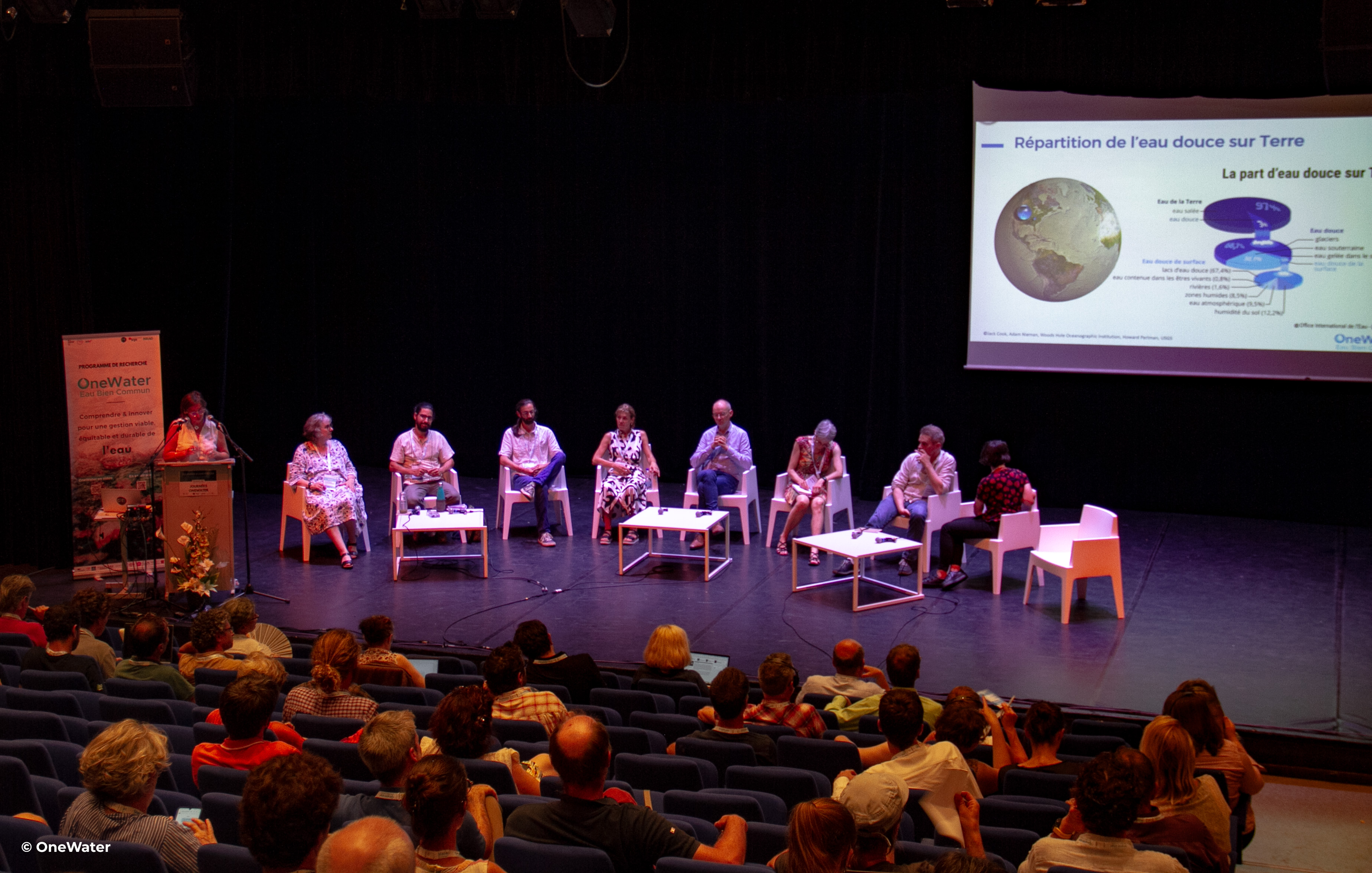
From 10 to 12 July, the OneWater Science Days took place at Claude Bernard Lyon 1 University. Nearly 200 participants gathered for this inaugural edition.
Aimed at the French water research community and stakeholders from the socio-economic sector, the conference brought together participants from diverse backgrounds to explore and discuss the challenges addressed by the OneWater – Eau Bien Commun national research programme.
The event was opened by Frédéric Fleury, President of Claude Bernard Lyon 1 University, with introductory remarks from the heads of the programme’s three lead institutions: Antoine Petit for CNRS, Christophe Poinssot for BRGM and Philippe Mauguin for INRAE.
Combining plenary presentations and small-group discussions, the Science Days featured fifteen workshops addressing the themes of the OneWater Challenges, alongside two round-table discussions on “water as a common good in a context of uncertainty”.
The discussions addressed both local and international issues. Anne Grosperrin, Vice-President of Lyon Métropole and Chair of the Eau publique du Grand Lyon public water utility, illustrated these themes by presenting Lyon’s permeable city initiative, which is being progressively implemented to restore water’s place in urban environments. Six of the thirteen members of OneWater’s International Scientific Committee (ISC) attended the event and drew on their own experiences to offer perspectives on the hydrological situation in France.
Join us in 2025 for the second edition of the OneWater Science Days.
Journées Scientifiques OneWater
© OneWater
The Science Days from the ANR's perspective: Read the ANR's review of this inaugural edition
OneWater Days - August 2025
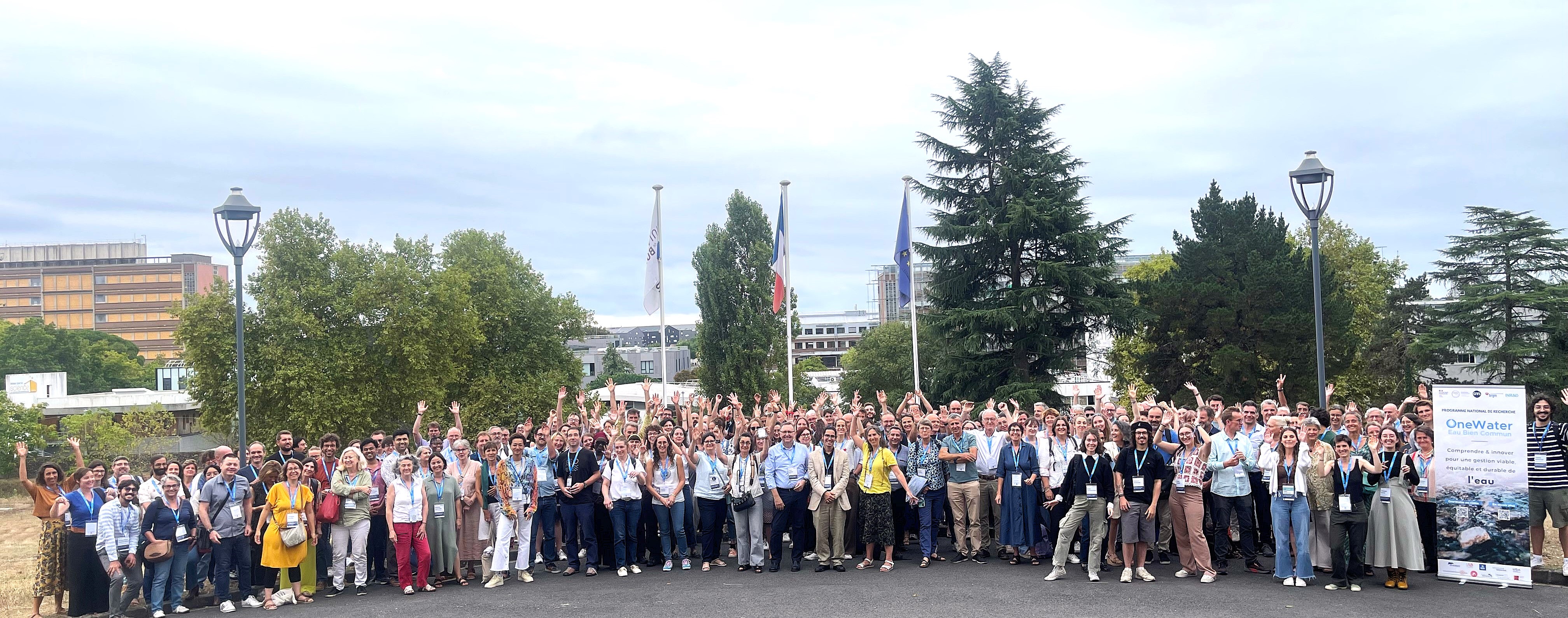
From 26 to 28 August 2025, Bordeaux hosted the second edition of the OneWater – Eau Bien Commun Days, bringing together more than 200 participants from across France. Researchers, public decision-makers, water managers and local stakeholders gathered around a shared goal: to exchange knowledge and strengthen collaboration in addressing water-related challenges.
Built around plenary presentations, round-table discussions and collaborative workshops, the three-day event offered a varied programme featuring an opening scientific lecture, four thematic round-table discussions, eighteen collaborative workshops, sixteen pitches by early-career researchers, thirteen scientific posters and three field visits, providing numerous opportunities for discussion and collective reflection. A gala evening also offered a welcoming setting for participants from different communities to meet and connect.
This second edition highlighted the scientific advances made through the OneWater programme, showcased local initiatives and strengthened dialogue between researchers, water managers and public decision-makers. Discussions opened up new avenues for reflection and action to address sustainable water management challenges in the context of global change.
Through this second edition, the OneWater Days reaffirmed their role as a gathering that brings together the French water community, demonstrating the OneWater – Eau Bien Commun programme’s ability to unite diverse stakeholders around a shared vision of water as a common good.
Journées OneWater 2025
@OneWater - Eau Bien Commun
Relive the OneWater Days 2025 in Bordeaux in pictures | OneWater – Eau Bien Commun
OneWater Open School - July 2026
Learning and Building a Shared Water Culture Through an Interdisciplinary Approach
From 6 to 10 July 2026, OneWater – Eau Bien Commun brought together 42 early-career scientists in Sète. Over five days, doctoral students, postdoctoral researchers and early-career engineers shared their knowledge and explored new ways of working together on water-related issues and socio-hydrosystems.
This edition reflected OneWater’s core values: breaking down disciplinary barriers, bringing together different forms of knowledge and encouraging new collaborations.
An interdisciplinary cohort from diverse backgrounds
Coming from institutions, laboratories and organisations across France, participants represented a wide range of regions and research contexts.
The cohort brought together around fifteen disciplines, including hydrology, hydrogeology, climatology, ecology, geography, geochemistry, microbiology, economics, sociology and management sciences.
Their research addressed topics such as groundwater resources, the effects of climate change, aquatic biodiversity, microplastics, water governance and sustainable territorial management. Nearly 70% of participants were not yet involved in a OneWater project, helping to broaden the programme’s community.
More than 30 contributors bringing together scientific and professional perspectives
More than 30 contributors supported the cohort throughout the week. Scientists from CNRS, BRGM, INRAE, IRD, Cirad, Ifremer and several universities shared perspectives with professionals working in water and territorial management.
Representatives from the Syndicat mixte du bassin de Thau, SUEZ, the Thermes de Balaruc, the Rhône Méditerranée Water Agency and Aqua-Valley took part in field visits, discussions and group presentations. This diversity helped connect scientific knowledge with local contexts and practical challenges.
A week combining training, fieldwork and collective experimentation
The programme combined lectures, practical exercises, scenario-based activities, interdisciplinary group work and field visits.
The field day featured five stops, from the Puits de l’Aven to Mont Saint-Clair, allowing participants to explore the different components of the local socio-hydrosystem and the challenges surrounding water management, use and conservation.
Workshops focused on interdisciplinarity, approaches to research, the FAIR principles for data and tools for studying the effects of global change.
During two “Apéro Posters” sessions, each of the 42 participants gave a three-minute presentation on the research topic of someone from another discipline. Finally, working in six interdisciplinary groups, they took part in an exercise to respond to a rapid call for proposals by developing a research proposal on socio-hydrosystems.
Alongside a week of research and training, the OneWater Open School 2026 provided a new generation of scientists with a space to connect, experiment and develop ideas together.
This approach lies at the heart of OneWater – Eau Bien Commun: understanding and innovating for viable, equitable and sustainable water management.